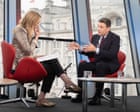
The PM oozes confidence and easy-going charm as he tells Laura Kuenssberg the hill he’ll die on is fixing social care
UK politics live – latest updates
In recent weeks there has been much speculation in some parts of the media that Andy Burnham would be calling an early general election. Speculation that existed largely in the heads of those writing the stories, as even the most favourable polls suggest that Labour would lose its huge majority and become the largest party in a coalition government. But to stop the chatter dominating his party conference, Burnham made it clear there would be no early election. His reward? Headlines in the rightwing press that he had bottled it. By not calling an election he had never planned to call. Sometimes you just can’t win.
There again, you might call this a first-world problem for the prime minister. This time last year, Burnham had been hanging around the fringes of the conference as he and his allies attempted one of the most half-arsed coups in living memory. One that fizzled out almost before it had started and became the butt of many jokes among Keir Starmer’s inner circle. Andy looked to have blown himself up on the runway, leaving Keir safe for the duration of the parliament.
Fast forward a year and Burnham is in Number 10, Reform’s lead in the polls has disappeared, and Labour is looking a lot more competitive than even the most rose-tinted party members could have reasonably expected in such a short period of time. Andy must be pinching himself. Unable to believe his luck. All that’s changed has been him. Energy prices are still sky high as a result of the war in Iran. The cost of living is still way too high. Nigel Farage and Kemi Badenoch might have been a problem for Keir, but they aren’t for Andy. You might even call them assets.
No wonder then that Burnham was looking relatively chipper as he kicked off the party conference with the traditional lengthy interview with the BBC’s Laura Kuenssberg. Only relatively chipper, because you’d need to be a halfwit not to be a little wary. These interviews can go hideously wrong – Liz Truss’s at the Tory conference in 2022 is a collector’s item – and prime ministers generally regard them as exercises in damage limitation. To survive without generating the wrong kind of headlines is the dream.
“You look like you’re loving the job,” observed Laura. Somehow biting her lip and refraining from adding that it is early days and we’ll see how much you’ve aged by this time next year. Andy smiled. He was, he said. Not because he had the job he had always coveted. But because now he had a chance to make a difference. To end the drift and division of the decade since Brexit – he could have gone back another five years and included austerity. To do politics differently. To bring back hope. You’re going to hear a lot of the H word in the next four days. It’s plastered over every wall of the conference centre.
And Burnham speaks as if he genuinely means it. He has the easy-going charm and self-confidence of a man who is comfortable in his own skin. He reaches parts that other politicians don’t get near. Nige has the same quality. Only where he speaks to people’s fears and grievance, Andy has a way of making you feel better about yourself. You may still struggle to pay your bills, you may still fight to get a hospital appointment, but somehow you can believe in better days ahead. The triumph of hope over experience.
All of which is a much in demand – if not essential – skill for a politician. One that gives you a fighting chance of success. People feel both heard and seen by him. It’s almost uncanny. Burnham talks of being a different sort of politician when the reality he is the archetypal career politician. You’d imagine he had spent years doing what he calls a real job as a hospital porter, but he’s been a politician almost all his adult life. Few understand the Westminster system better than him, he also suggests. You can’t escape the irony. Keir Starmer actually had a long and successful career outside politics, but he is the one who always sounded like the career politician. Speaking in soundbites and half-truths. You’ve either got it or you haven’t.
The message Burnham really wanted to get across on Sunday morning was that social care was the hill he would die on. Other politicians had said they would tackle the issue but had recoiled when they realised how difficult it was. “I will grasp the nettle,” he said, opening his eyes still wider, hoping that viewers would fall into them. He would create a national care system that incorporated the NHS and social care. Old people were either paying through the nose for their own care, falling through the cracks or ending up bed blocking in hospitals. It was unsustainable and undignified.
How this would be paid for would be laid out in due course. It would be what Labour would campaign on in 2029. But make no mistake, people were already paying for it. Here he was preaching to the converted. My sisters and I had to sell my mother’s house to pay for her care during the last seven years of her life as she suffered from Alzheimer’s. We didn’t mind so much, but my mother would have been gutted had she been aware. It had mattered to her that she could leave her house to the three of us. Paying a little extra in tax to make sure that other people – possibly even you – don’t have to burn through their assets seems the kind of thing any fair-minded society would do.
Burnham ended by saying he very much hoped to work cross-party on all this. It was too important not to. This aspiration lasted all of five minutes. Because that’s how long it took the ever ridiculous Chris Philp – Kuenssberg’s next guest – to start going on about a “death and dementia tax”. Like clockwork. The Philpster becomes more and more a parody of himself. The Tory party’s very own Alan B’Stard. Venal, self-serving and not very bright. A man whose answer to everything is to cut the welfare bill still further, seemingly unaware his leader has already spent the cuts her party has proposed.
It’s as if Philp regards getting dementia as a personal failing, just as he sees being on benefits as morally deficient. If you get dementia then you deserve to pay for your own care. Now is not a good time to be one of Chris’s relatives. If you find yourself in need of care, then you’re very much on your own. There’s no way the Philpster is missing out on his inheritance.