Community-funded archaeological excavations of ‘really important’ sixth-century monastery also rewrite story of Lismore
To the residents of the Scottish island of Lismore, population 190, history is never very far away. The tiny island near Oban in Argyll has no row of shops or even a pub – if islanders want to meet for a coffee, the only place to do so is in the lively Gaelic heritage centre that records the many centuries of community life on the island.
This quiet place, documentary evidence records, was home to a monastic settlement in the sixth century AD, when missionaries from Ireland were first moving into northern Britain to spread Christianity. But apart from a few fragments of an early carved cross, there was almost nothing to see from this period of history.
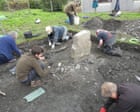
A group of local people from the island’s historical society were determined to look a bit harder, however. After scraping together funding from grants, donations and legacies of locals and a crowdfunding campaign, they commissioned a professional archaeologist, Dr Clare Ellis of Argyll Archaeology, to lead a group of islanders and other volunteers in an excavation on the site of a much later medieval cathedral.
Their “hugely exciting” findings have not only rewritten the story of the island but cast new light on the spread of Christianity in the period, according to archaeologists. What the islanders discovered were extensive burial grounds, decorated stonework and early buildings – all the features belonging to a major sixth-century monastery, comparable to the much better known site of Iona a little to the south-west.
In addition, the excavations uncovered rare evidence of slightly later high-status craftworking, including huge numbers of crucibles which had been used to cast gold and silver. The finds have shown that rather than being a small island church in an overlooked backwater, the monastery of Lios Mór, founded by Saint Mo Luóc or Moluag, was a high-ranking site of international importance, experts say.
To Robert Hay, a retired plant scientist who moved to the island in 2001 and who coordinated the fundraising and volunteer efforts, the experience was thrilling. “We were [excavating] in this really unfavourable, boggy area. To be digging out the best small crucibles ever found in Scotland – it’s extraordinary,” he said.
“The most exciting moment for me was when they were doing the post-excavation analysis and they found that they had been melting gold, copper, silver, and they were making jewellery on our little island in the seventh century.”
While plenty of islanders have an idle interest in its history, a “dynamic minority” of mostly older people had mustered the volunteers and funds to carry out the digs, said Hay. Raising the low five-figure sum needed to pay for it all had been “just a business of getting down to it and organising and so on”, he said. “It was actually a lot easier than what my previous job used to be.”
Gordon Noble, a professor of archaeology at the University of Aberdeen, said the finds were highly significant. “We know about sites like Iona having these very famous monastic sites from this early medieval world. But apart from the association with Moluag and a piece of sculpture from this site, we knew practically nothing really about Lismore. So it was hugely exciting to see the results emerging through the local group’s work with Clare [Ellis] … This was clearly a really important early Christian establishment.”
While professional archaeologists often worked with local people, Noble said, “it’s not always the community themselves coming up with the ideas. Here, it was very much a bottom-up approach of the heritage society coming up with a plan, working with professionals – and lo and behold, what a great series of discoveries they’ve made at the site.”
Hay said he hoped the finds would go some way to restoring the reputation of Moluag, who has long been overshadowed by the more celebrated Saint Columba, the founder of Iona and the subject of an influential ninth-century biography. “Unfortunately, Moluag never had a hagiographer, so his contribution to the evangelisation of Scotland has been very much underestimated,” he said. “So finding his monastic site and [the evidence of metalworking] – it’s all about recalibrating the situation. I think Moluag had a very big impact on the evangelising of Scotland, but unfortunately, he didn’t get his PR right.”
The results of the community excavations will be published in the forthcoming edition of Antiquity.