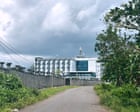
Group trapped at Hotel Bamy after US removal as rights groups sound alarm over poor conditions and violence
Two men that the Trump administration expelled to Equatorial Guinea were bound, fitted with bags over their heads, beaten and pushed down a flight of stairs, all in plain view of other US deportees, according to witnesses and human rights lawyers.
The men – one from Egypt and one from Eritrea – were then taken to a prison. About 30 detainees from the US remain trapped at a hotel in the outskirts of the coastal city of Malabo after being deported from the US. Detainees have said they believe the men were beaten for telling the press and human rights advocates about the poor conditions and violence inside the hotel, and that they are haunted by flashbacks and terrified they will be retaliated against next.
Human rights advocates and experts have warned for months that conditions at the Hotel Bamy – a run-down establishment that has served as a detention center for US deportees – are dangerous.
The US has sent at least 66 people from different African countries, Cuba and Brazil to Equatorial Guinea, which has received $7. 5m as part of a deal to cooperate with the US deportation program. The Trump administration has pursued dozens of similar deals with countries to take in immigrants that the US cannot deport directly to their home countries, where judges have deemed they would face torture or persecution. In the past, the US government allowed those people to live and work in the US indefinitely.
The Trump administration, however, has sought instead to expel them to third countries where they have no ties, do not speak the local language and have no legal status – trapping them in limbo.
Advocates have been especially concerned for deportees sent to Equatorial Guinea, where the authoritarian government is notorious for human rights abuses, including torture, according to the US state department. Detainees held at Hotel Bamy have told the Guardian that armed guards keep watch over them 24/7, and that they have not been provided any medical care or even fresh clothes since arriving there. One of the detainees, who has a severe stomach hernia that requires visits to the hospital to drain his stomach due excessive fluid build-up, said he has been unable to see a doctor since arriving at Hotel Bamy.
Other detainees have managed to obtain medication for HIV, diabetes and other conditions via human rights lawyers, but remain fearful that access to medications will be arbitrarily cut off.
The two men who were tortured – Ahmed Soliman, 31, of Egypt, and Samson Birhane, 47, of Eritrea – have since been transferred to a prison in Malabo. Multiple witnesses recounted that the police officers shouted, “Where is the phone? Where is the phone!” as they beat the men, who had initially been accused of breaking a mirror at the hotel before they were pulled aside and arrested.
The beating, which occurred on 11 September, followed the release of a video first reported by Reuters showing conditions at the hotel and the violent behavior of the guards. The detainees had been using cellphones to communicate with lawyers and the media about the conditions they were facing.
In the video taken by Soliman, which lawyers shared with the Guardian, authorities are seen pointing guns at the deportees. A Cuban man asked the officer for the return of his confiscated mobile phone so he could contact relatives and a lawyer, but was ignored. When officers noticed Soliman filming the exchange with his mobile phone, multiple officers rushed at him and others standing nearby, pointed their guns, and told Soliman to remain on his knees with his hands up for 10-15 minutes.
In another video, Soliman was able to film authorities forcibly sending US deportees to Ethiopia, where they are likely to face torture. When deportees resisted going with authorities, officials gave them the option to “go back to their home country” or “go to prison”. At least 12 people have been returned by Equatorial Guinea to their home country, where they face persecution.
In May, human rights experts at the United Nations issued a rare public appeal asking Equatorial Guinea to halt plans to return deportees to their home countries and to comply with international human rights standards and avoid refoulement, or the expulsion of people to countries where they face persecution.
“This is a human rights catastrophe,” said Bella Mosselmans, director of the Global Strategic Litigation Council, who represents several of the deportees at Hotel Bamy. The US and Equatorial Guinea “must be held accountable for the atrocities they are committing”, she added.
In the week since Soliman and Birhane were beaten, police have also been searching the other detainees’ hotel rooms for cellphones, and have confiscated them. They have also barred lawyers from seeing the deportees. Authorities have told the 29 US deportees who remain at Hotel Bamy that they may never see Soliman or Birhane again, according to lawyers. One detainee who witnessed the beating said authorities treat them as if they are “blanks” who “don’t even exist”. Another detainee said an officer told her: “You will disappear from the earth. I am the law.”
Witnesses said they feared for the lives of Soliman and Birhane, who came to the US as children.
Soliman is a gay man from Egypt who had lived in Phoenix for most of his life. He had a green card, but lost status after he was convicted of drug possession. He served time for his crimes, and in October, a judge had determined he would face persecution and torture if he were to return to Egypt due to his sexuality.
Birhane had come to the US as a refugee when he was 13, but lost status after a conviction for robbery when he was in high school, in 1988. He was allowed to remain in the US after a judge ruled he faced torture in Eritrea, and had been regularly checking in with Immigration and Customs Enforcement as required.
Lawyers for the deportees shared copies of multiple emails they had sent to the US embassy in Equatorial Guinea alerting them to threats and violence against those detained at Hotel Bamy, but those messages have gone unanswered, they said. In July, amid a lawsuit challenging conditions for deportees, the African Commission issued an urgent interim order instructing the government of Equatorial Guinea to refrain from deporting, transferring, or relocating deportees against their will.
The US Department of Homeland Security did not respond to the Guardian’s request for comment.
A spokesperson for the state department said: “The US government will use all legal means to remove those with no right to remain in our country.”
The agency did not respond to questions about whether it was aware of how Equatorial Guinea was treating US deportees, nor would it acknowledge whether any measures have been taken to intervene.
“As a general matter, we do not comment on the details of our private diplomatic communications with other governments,” the spokesperson said.