No headway in Middle East peace efforts as US and Iran refuse to yield
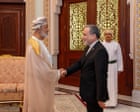
Deepening sense of deadlock despite regional diplomacy as Washington and Tehran show no signs of compromiseHopes of a breakthrough in negotiations between Iran and the US faded further on Sunday, amid a deepening sense of a deadlock in the nearly two-month-long conflict despite intense regional diplomatic activity.Washington and Tehran appear unwilling to moderate rhetoric or make concessions, and there are no negotiations scheduled that might bring the war to a definitive end.On Sunday, Abbas Araghchi, Iran’s foreign minister, returned to Pakistan for a second consecutive days of talks with mediators after a brief trip to Oman for discussions there.Araghchi described his Pakistan trip on Saturday as “very fruitful” but signalled scepticism over Washington’s intentions. “Have yet to see if the US is truly serious about diplomacy,” he said on X.On Saturday, Donald Trump announced that he had cancelled a visit to Pakistan by his envoys, Steve Witkoff and Jared Kushner. The two men were to take part in a second round of talks with Iran which had been tentatively scheduled for this weekend.Speaking in Florida before being rushed out of the White House Correspondents’ Association dinner in Washington after a gunman fired shots at his security detail, Trump said the visit involved too much travel and expense for what he considered an inadequate Iranian offer.The cancellation came after Iran said it would not be attending any direct talks while the US blockaded all shipping to or from the Islamic Republic.Trump later claimed that Tehran had offered a new proposal for agreement within minutes of his decision.“They gave us a paper that should have been better and – interestingly – immediately when I cancelled it, within 10 minutes, we got a new paper that was much better,” he told reporters, without elaborating.Pakistani officials have sought to rebuild momentum in the negotiations, briefing media that progress towards a possible “bridging agreement” to allow discussions to restart was being made.A round of talks in Islamabad earlier this month – in which a US delegation led by the vice-president, JD Vance, met Iranian delegates led by Iran’s parliamentary speaker, Mohammad Bagher Ghalibaf – ended without any apparent progress towards a deal.The 21-hour session earlier exposed wide gaps on the future of the strait of Hormuz, Iran’s nuclear programme and Tehran’s longstanding support for militant movements around the Middle East.The talks collapsed after Iran would not agree to US demands to end nuclear enrichment and hand over its 440kg of highly enriched uranium.Last week, Trump announced an indefinite extension of his earlier two-week ceasefire with Iran and repeated his demand that Iran allow shipping free passage in the strait of Hormuz, which in normal times carries around a fifth of the world’s oil and liquid natural gas supplies.The closure of the strategic waterway through the Gulf has sent oil prices soaring around the world, threatening a global economic downturn.In an attempt to pressure Iran, Trump ordered the US fleet assembled off its shores to blockade Iran, which is heavily dependent on the sale of oil to stave off total economic collapse.Analysts say Iranian leaders are aware the US president faces pressure himself from US voters unhappy at rising fuel prices, and may be forced into concessions earlier than Tehran. Midterm elections are due in the US in November.Iran’s Islamic Revolutionary Guard Corps (IRGC), whose grip on decision-making in Tehran, experts believe, has been reinforced during the conflict, said it had no intention of lifting its blockade.Iran wants to raise a toll on passage through the strait, forcing each passing tanker to pay $2m. This could lead to higher prices for years to come.The IRGC wrote on its official Telegram channel: “Controlling the strait of Hormuz and maintaining the shadow of its deterrent effects over America and the White House’s supporters in the region is the definitive strategy of Islamic Iran.”Iran’s military warned in a statement carried by state media that continued US “blockading, banditry and piracy” would lead to retaliation.Trump has ordered the military to “shoot and kill” Iranian vessels that could be placing mines. Though the US has sunk almost all of Iran’s conventional navy, small fast boats used by the IRGC still pose a significant threat. Last week three ships were fired on by Iranian forces.Analysts said Iran had held the upper hand since the abortive first round of talks in Islamabad.“Both the US and Iran put lists of respectively 15 and 10 maximalist demands on the table that transgressed known red lines of their interlocutors,” Hamidreza Azizi and Erwin van Veen wrote last week for the Dutch Clingendael Institute of international relations.“But neither the military situation nor the military outlook at the time supported the idea that major concessions were on offer compared [with] prewar positions.If anything, the strategic stalemate that led to the ceasefire favoured Iran because the US cannot reopen the strait of Hormuz without a large-scale and risky ground operation.”Writing on Truth Social before the Washington dinner shooting, Trump said there was “tremendous infighting and confusion” within Iran’s leadership.“Nobody knows who is in charge, including them,” he posted. “Also, we have all the cards, they have none! If they want to talk, all they have to do is call!!!”Analysts say that though there are deep divisions among Iranian leaders and factions, all are committed to presenting a unified front to the US.Iran’s president, Masoud Pezeshkian, said last week there were “no hardliners or moderates” in Tehran and that the country stood united behind its supreme leader.A further challenge is to maintain the fragile ceasefire in Lebanon, which Tehran sees as essential to its participation in any talks. Israel struck southern Lebanon on Saturday, killing at least six people it said were Hezbollah militants, and several rockets and drones were launched at Israel from Lebanon.The conflict is one of the widest in geographic extent in the Middle East since the second world war, with violent attacks from Azerbaijan to Oman and even in the Indian Ocean.At least 3,375 people have been killed in Iran by joint US-Israeli strikes, according to local medical authorities. About 2,500 people have been killed in Lebanon, where Israel launched a relentless offensive after Hezbollah fired missiles into Israel in retaliation for the Israeli strike in Tehran which killed Iran’s supreme leader, Ali Khamenei, and launched the war.More than a dozen people have been killed in Gulf Arab states and 23 in Israel by Iran’s retaliatory attacks, including those launched by its proxies. Fifteen Israeli soldiers in Lebanon, 13 US service members in the region and six UN peacekeepers in southern Lebanon have been killed.