While Brussels and Ottawa desire a deeper partnership born of Trump-era volatility, the EU has no legal framework to accommodate it
Don’t get This Is Europe delivered to your inbox? Sign up here
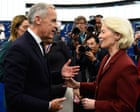
The EU and Canada, Ursula von der Leyen said last week, “see the world with the same eyes”, with shared stances on everything from AI to the climate crisis, the Ukraine war and the unholy chaos unleashed by the current occupant of the White House (OK, she didn’t actually say that last bit. But I like to think she almost certainly thought it.)
So, the European Commission president went on, Canada should become “the first associate member of the EU”. In the audience, Mark Carney beamed with delight. The next day, Canada’s prime minister enthusiastically embraced the idea of an “alliance for the future”, to build “collective resilience” through “deep cooperation”.
Cue standing ovations, warm handshakes – and a great deal of head-scratching in Brussels and assorted EU capitals. Because “associate membership” of the EU is not, in fact, a thing. Nor, as a Guardian editorial pointed out, is there “any blueprint for what such a thing might involve”.
The term was, the editorial argued, “a political hypothesis”, describing “a relationship of intimate strategic alignment with the EU, stopping short of actual membership, in ways that are significant but undefined”. So what exactly are the commission and Canada playing at here, and where might it lead?
You can see where they’re coming from. On paper, in a world of unpredictable and increasingly aggressive great powers, it makes perfect sense. For Canada – which already has the Ceta free trade agreement with the EU – the catalyst for even closer cooperation is clearly Donald Trump: incessant tariff threats, an escalating trade war, bullying talk of Canada as the “51st state”, the renaming of Lake Ontario – all have left Ottawa eager to diversify its relations.
Aligning with European industrial strategy, working together on defence and AI, and joining EU scientific research and student exchange programmes would offer Canada a reliable counterweight to its all-too-unreliable southern neighbour. (Unsurprisingly, Trump called the tie-up “laughable”, and threatened more tariffs.)
For the EU, meanwhile, Canada is a dream partner: a stable, like-minded “middle power” rich in critical minerals, rare earths and – as Carney couldn’t resist noting – good manners. Plus, Canada’s unbridled EU-enthusiasm is a pleasing boost to the bloc’s bruised ego after Iceland’s recent rejection of more EU accession negotiations.
There’s only one problem: “associate membership” is not a status in the EU treaties, and creating such a status would mean treaty reform, which member states won’t contemplate. There are things called “association agreements”, such as with Ukraine, Moldova or Georgia, but those are essentially stepping stones to full membership – which Canada can’t aspire to, for the very good reason that it isn’t in Europe.
But if “associate member” sounds vaguely familiar, that’s because the EU has been talking about a “second circle” since the days of Jacques Delors: an outer ring of countries bound by shared values, free trade and security cooperation to an inner core of members, but without full voting rights or complete regulatory integration.
Emmanuel Macron’s European Political Community is a variation on this theme, and Germany’s chancellor, Friedrich Merz, recently floated “associate member” status for Ukraine. Indeed, non-EU nations in the European Economic Area (EEA) and European Free Trade Association, such as Norway, Iceland or Switzerland, already function as quasi-associate members, enjoying single-market access while being largely “rule-takers”: adopting EU rules without having a vote in Brussels.
Writing in the Guardian, Fabian Zuleeg suggested that Canada and Europe actually need more of an “integrated partnership” – a model that leaves single market access to one side, focusing instead on concrete collaboration in areas such as defence, supply chains and EU programmes like Horizon and Erasmus+.
Alberto Alemanno, a professor of EU law, noted that a realistic EU-Canada landing zone would have to go further than Ceta and might more resemble the kind of tailored framework of the EU-Swiss relationship. But the real significance of any formal new status, he said, was that it could make the EU “an institutional hub around which other democracies organise strategic autonomy – but without joining the union”.
What that might actually look like is anyone’s guess: visa-free work access, shared military procurement, Canadian seats on EU regulatory committees? For the moment, Canada’s hypothetical “associate membership” is more of a mood than a reality: the expressed intent of a democratic bloc and a middle power to deepen ties in the face of mounting global uncertainty.
Does it, all the same, hold any hope for Brexit-regretting Britain? As Jill Rutter of the Institute for Government highlighted, the EU’s sudden willingness to display “institutional imagination” at least shows that the bloc is willing to think about adapting when geopolitical pressures demand.
But a new deal for Canada won’t automatically fix the UK’s issues. As Joël Reland of UK in a Changing Europe pointed out, the vagueness of the EU offer to Canada might look promising for the UK. But Canada wants “deep cooperation” without touching single-market rules, and the UK’s main problem is that it is now shut out of that same market. Whatever Canada eventually gets, it’s unlikely to work for the UK.
Friedrich Merz is in trouble. A fortnight after the far-right Alternative für Deutschland (AfD) swept to a crushing victory in one state election in Saxony-Anhalt, the German chancellor’s centre-right CDU failed to clear the 5% threshold needed to enter the state parliament in another, Mecklenburg-Western Pomerania.
It fared a little better in Berlin, where it was the incumbent, but was still beaten – by a clear five-point margin – by the far-left Die Linke. And the AfD made headway in the capital, too, surging to a double-digit result. The embattled chancellor has vowed to fight on, but faces an uncomfortable choice: revise the unpopular economic reforms he insists are essential, or risk oblivion defending them.
Meanwhile, as long as he refuses to step aside and no one is actively seeking to replace him, a volatile and damaging deadlock will reign in Europe’s biggest economy. After 16 months in office, it is becoming increasingly clear – as a Guardian editorial noted – that Merz is “ill-suited for the job” of defending Germany’s democratic future against the far right.
To receive the complete version of This Is Europe in your inbox every Wednesday, please subscribe here.